Can you trust the Bible?
Can you trust the Bible is a question often asked and it is no suprise because no other piece of writting has been attacked so much. Really there are 2 question mixed into one and that is how I am going to approach it. Click Here to see the second question answered Firstly are the writings that we have now, that we refer to as the Bible, are they the same as what was laid down in writing at the time of writing or have they been corrupted either by accident or maybe even on purpose?
The second question is, even if they are exactly the same as what was written at the time all those centuries ago, are they the word of the true God and thus trustworthy for us to use and follow?
On this first section I will be dealing with the first question - are the scriptures reliable? I will address the second question on another page.
The Bible comes in two section which we call the Old testament and the New Testament. Each Testament itself is made up of a number of books - 39 in the Old and 27 in the New. In fact the word "Bible", means a library.
Has the Bible been changed over the years?
There is a commonly held preception that each translation of the Bible is based on a previous translation. For example any translation we have in a modern lanugage (say English for example) is translated from an older translation such as Latin. This is not the case. Nearly every modern language translation and versions centuries old are translated from the older manuscripts that are written in their original languages such as Greek and Hebrew. A few books were written in Aramaic such as Daniel and Ezra.
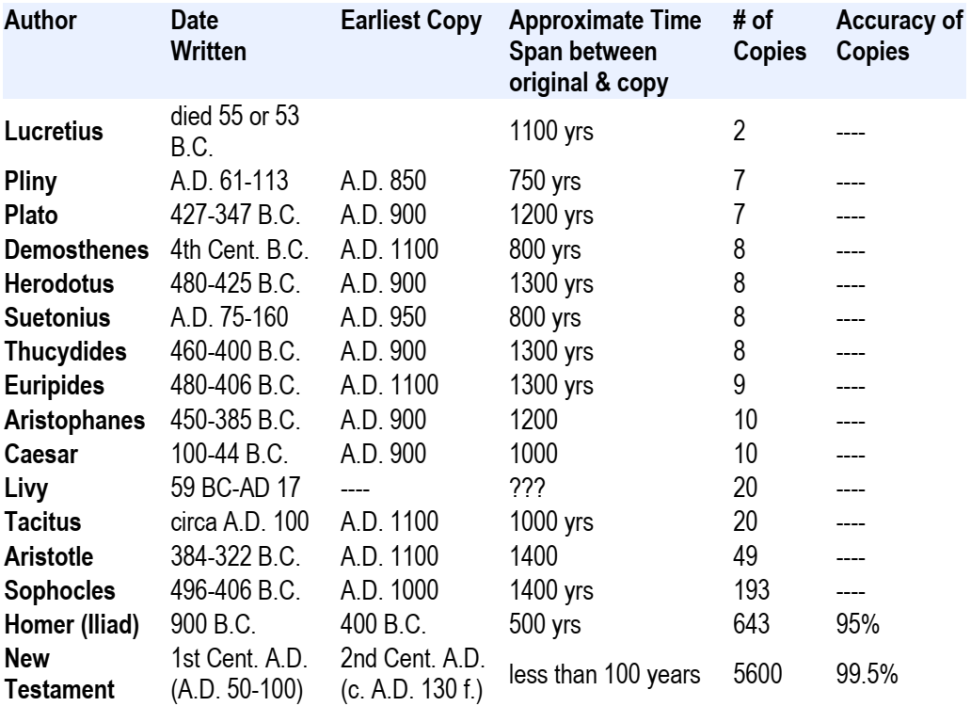
A follow on question to this would be "but how can we trust the manuscripts we have when they could be hundreds and maybe thousands of years old"? Again this is not the reality. The table belows below reveals not only how many old manuscripts for the New Testament there are but how close they are to the time of the events they relay. As you can see they far surpass any other piece of literature.
This is a commonly quoted statement but that is far from the facts.
There are about 140,000 words in the Greek New Testament, and scholars estimate there are about 400,000 variant readings, or about 3 per word on average! However these variations are spread across more than a million pages of almost 25,000[1] manuscripts, so the number of variations is about one word every second page.
Now lets us have a closer look at these variations.
Firstly (and this is by far the most common reason) most of the differences are down to differences on how to spell certain words and names - especially names. For example the spelling of a lot of names can have many different versions. We see this today in the English langauge and is more prevalent when tranlating from one language to another as would have been the case with the New testament having an Hebrew name but having been translated into Greek.
The second variation is changing the word order which does occur some times. This can make a major difference in English and a lot of other languages but makes no difference in Greek which uses word suffixes to define the meaning of the sentence.
Thirdly, variation can be down to a simple human mistake by the scribe. Due to the time and expense of copying and also the importance of the task to the scribe, the scribe would take as much care as possible not to make mistakes. That said human error could occur but the statastical chance that those would change the meaning are low, especially with a language such as Greek. Most of those mistakes are either the missing out of a word or the duplication of a word. In most cases they are easy to identify and even if they wasn't, they would be another 5600 manuscripts to compare to.
Finally on this subject of variartions, it is known that there are 3 significant and one slightly less so suspected additions to the manuscripts.
Two of these are larger passages which are generally believed to be later additions to the original text, (and are set apart and marked as such in most Bibles), are John 7:53-8:11, where Jesus intervenes to stop a woman being stoned to death for committing adultery, and Mark 16:9-20, an ending of Mark’s gospel, (which otherwise seems to finish abruptly).
The words of Luke 22:43-44 (An angel from heaven appeared to him and strengthened him. And being in anguish, he prayed more earnestly, and his sweat was like drops of blood falling to the ground.) appear to be an addition. They are included in most Bibles, but a footnote explains that they may not be original. In addition, an extra 25 words (in English) appear to have been added to 1 John 5:7-8, apparently to give greater support to the doctrine of the Trinity. This has been known for centuries and most Bibles retain this section only in a footnote.
N.B. Link to 1 John 5:7-8 is NIV which does not have the additional 25 words - see KJV.
None of these suspected additions change the message of the Gospel in anyway and if the reader chooses to ignore them, they will not find themselves having any lack of scripture to guild them.
Conclusion to be drawn about New Testament variations
The very important point here is that the large number of variations comes about because there is a large amount of manuscripts availble. If all the manuscripts were identical then it would be very suspicious. It is like witnesses giving evidence in court - if they all said the identical same thing, then it would smell of collusion between the witnesses. Not that I am saying it is the same thing for scribe to copy a written piece of work as for a witness to give a verbal statement but when so many scribes can agree so closely then that piece of work has to be taken seriously. Remember none of the spelling errors etc changed the message held within those early manuscripts
Okay then the New Testament is reliable as a piece of literature but what about the Old Testament - that is many centuries older than the New Testament?
Where are the ctitics from the time of the writing of the New Testament?
This point was drawn to my attention in a book by Nabeel Qureshi called No God but one, Allah or Jesus? His arguement is that if anyone had made changes to the letters and manuscripts that were very quickly being copied and spread around the early Church then this would have caused members of the early church to complain. We actually see this with the Bible today in that certain sects see fit to write their own versions of the Bible while making the claim that these are the only true versions and the rest are wrong. We see this with the Mormons and the Jehovah witnesses for example. In fact you see it within the Church proper - every version of the Bible is analysed and discussed to the nth degree. Even the smallest perceived error is spotted and has a spot light shone on it. There is no reason why it would have been any different in the first century.
References and notes
[1] This number of 25000 includes manuscripts in other languges other than the 5600 in Greek such as Latin.
The Christian Apologetics & Research Ministry (CARM) https://carm.org
The John Rylands Library http://www.library.manchester.ac.uk/rylands/
Tynedale House http://www.tyndale.cam.ac.uk
The origin of the Bible http://www.truthnet.org/Bible-Origins/
Dead Sea Scrolls (Qumran Manuscripts)
https://www.deadseascrolls.org.il/
http://www.jewishvirtuallibrary.org/history-and-overview-of-the-dead-sea-scrolls
http://www.centuryone.com/25dssfacts.html
http://dss.collections.imj.org.il/
Nabeel Qureshi website http://www.nabeelqureshi.com
Also see - Josh McDowell, Evidence That Demands a Verdict, rev ed. (San Bernardino, Calif.: Here's Life,1979), p. 42.


The oldest fragment of the New Testament. The Gospel of John, now belonging to the John Rylands Library, The University of Manchester. It is dated at around 125-150 CE
With the Old Testament we have the same strong augrument about volume and accuracy of manuscripts but we also have the added fact of the discovery of the Dead Sea scrolls - more properly called the Qumran Manuscripts. It isn't that we needed the evidence they bring because there was already a wealth of manuscript data, but the fact that they had laid hidden from as far back as 250 BC.
They were discovered in 1947 by a young sheperd boy in the caves of Qumran. What he found were some leather manuscripts in clay jars. Over the next 10 years, further manuscripts were found and we now have whole of the Old Testament with the exception of the book of Esther. The find consisted of both whole books and fragments of the books of the Old Testament (accept the book of Esther). In the early find were 2 complete copies of the book of Isaiah and it was observed that they were in 95% agreement with what we have today and the 5% difference were mainly slips of the pen and spelling mistakes.
The manuscripts were put there by a Jewish sect called The Essenes who lived in the region up to about 100 AD.
When these manuscripts were dug up, a lot of myths by Bible critics were buried.
If you want to know more about the Dead Sea Scrolls, see the links below. If you want to see more of the science of Old Testment Biblical Inerrancy and textual criticism then check out this link.
Have a look at my second part on this - "Is the Bible the word of God"

Are not these manuscripts full of errors and contradictions?
Now don't get me wrong on this. I am not saying that it is the number of Manuscripts that proves a point but rather the quality of the manuscripts that matters. When I say quality I am not referring to it being in a mint condition as though it has just been written with no damage due to age or insect attack. What makes for quality is how close it is to the time of the writing of the original (know as the autograph) and its agreement with other manuscripts from the same time period.
On the question of the accuracy of copies, I wouldn't agree with the 99.5% value given in the table. New Testament scholars such as Daniel Wallace say that they are happy with the New Testament to about 98% when all the evidence is assembled. This doesn't mean the other 2% is a problem - just that it is difficult to be clear what was in the autograph.
One thing stands and that is that the New Testament has by far the largest amount of old manuscript evidence in its defence.
Two Questions
I can not leave it like this!
The purpose of this website is not about exposing the lies and deceit of your particular belief and then leave with no hope and nothing to believe in and no purpose in your life. While it may be a good thing to realise it if you have been lied to too or deceived, this does not mean there is no truth out there.
There is truth and something that you can believe in and commit to and it will change your life – not just for now but for all eternity. Now I am not saying all your problems and troubles will disappear while you are alive in this present world but what you can have is a peace that is greater than your worldly problems. I want to be clear on this – for some people, becoming a Christian could make your life a lot harder. But despite all this, you can have a purpose in your life despite what circumstances you find yourself in. You can have a real fellowship with the living God and actually have God himself dwelling inside you by His Holy Spirit. No one ever regrets becoming a Christian. In the end we will spend eternity with Jesus in paradise. As Paul said “For our light and momentary troubles are achieving for us an eternal glory that far outweighs them all.” (2 Corinthians 4:17). If you read the book of Acts and see what Paul went through, it is remarkable that he would describe them as “light and momentary troubles.”
The good news is that free and available to all of mankind. You don’t have to be clever or rich or gifted or be from a certain family or country. Anyone can receive it.
The Bible tells you all you have to do is “Believe in the Lord Jesus, and you will be saved.” That is taken from Acts 16:31. One of the most famous verses from the Bible has the same message, “For God so loved the world that He gave His one and only Son, that everyone who believes in Him shall not perish but have eternal life.” (John 3:16).
There are actually a lot of Bible verses that have the same message about salvation being free and simple but I will quote just one more on this which is Ephesians 2:8-9 “For it is by grace you have been saved, through faith—and this is not from yourselves, it is the gift of God— not by works, so that no one can boast.”
It is a very important principle to grasp that we can bring nothing to our salvation. It is a gift from God by His grace and we can not add any of our own works to it.
So what to do now?
Of course you can simply just commit your life to Jesus by asking him to forgive all your sins, and asking Him into your life as your Lord. Making Him your Lord will mean that you allow Him to be the Lord of all your life, which means you seek his will in all you do. On occassions you will fail to obey him, but "If we confess our sins,he is faithful and just and will forgive us our sins and purify us from all unrighteousness (1John1:9)." If you feel you are not ready to take that step but would like to know more, I would recommend getting hold or download the Bible and start reading it. I would suggest starting in the New Testament but all of the Bible is good for you. It would also be helpful for you to find a good church and go along and ask all those questions that you would love to get answers to.
Also you are very welcome to contact me on my email gospeljohn14verse6@gmail.com and I will help in anyway that I can.
God Bless. Kevin.